
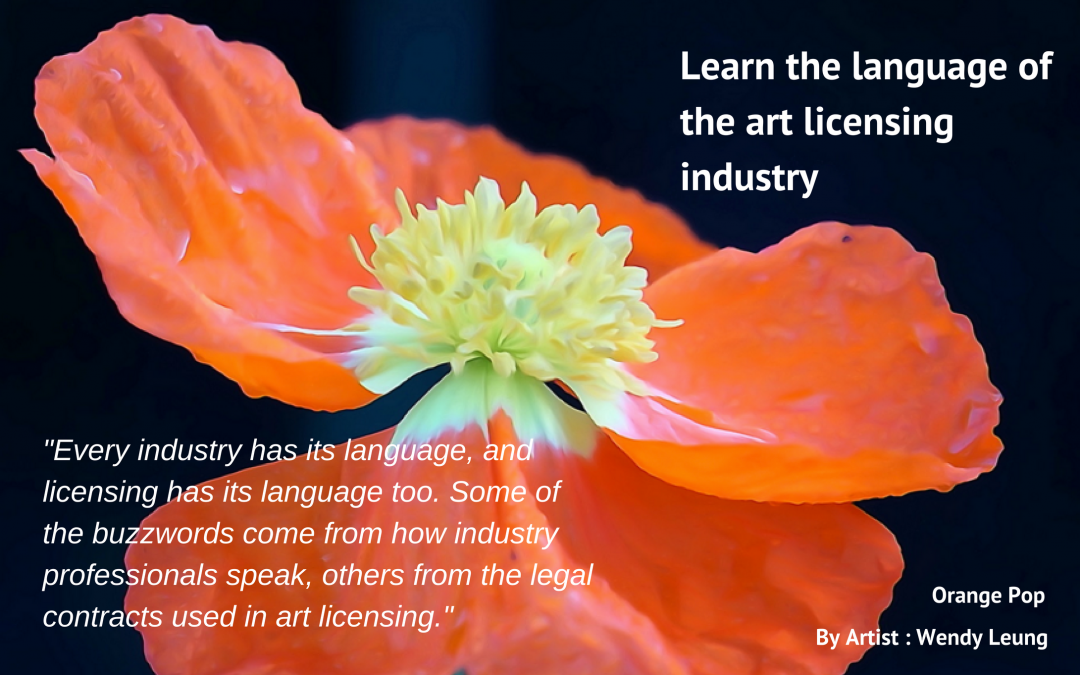
Artist: Wendy Leung Artwork : Orange Pop License This artwork
Every industry has its language, and licensing has its language too. Some of the buzzwords come from how industry professionals speak, others from the legal contracts used in art licensing.
My aim this week is to familiarise you with that language so you can understand it and speak it, too. From today, I will use this language regularly in future newsletters so it will become a second language to you. Keep this newsletter as a useful guide.
Most commonly used terms:
Being familiar with, and having the knowledge, of the following terms will serve you well when in conversation with potential clients and attorneys.
License: A legal grant of the temporary rights for a company, person or entity to “rent” or “use” your art. The permit specifies what they can use it for, for how long, where and how.
Property: Art, logos or brand that you own the copyright and trademark too. Property refers to intellectual property and is sometimes interchanged with the terms art, image or design.
Licensee: The client, company or entity that is licensing your PROPERTY (art).
Licensor: That's you, the artist. The LICENSOR is the person who owns the PROPERTY (the art) being licensed.
Distribution channels: Where you allow your PROPERTY (art) to be sold. There are many different DISTRIBUTION CHANNELS, below are the most common:
MASS MARKET: (Walmart, Kmart and other giant mass retailers)
MID TIER: Department stores such as Macy's and Nordstrom
UPPER TIER: High-end department stores such as Saks Fifth Avenue and Bloomingdales
SPECIALITY: Boutiques, and niche stores
ONLINE: Online sales at the Licensee’s website
Distribution channels are essential as you need to control where your products will be sold. This is important for artists who want their art to appeal to the affluent and want to see it on top quality products. Or artists wishing their work to be available to many people may target the mass market. Distribution channels can affect how much you can agree on royalties. I’ll go into detail on this that later.
Territory: Describes an assigned area of responsibility. A salesperson, for example, may work in a particular territory. In art licensing, assume the licensor has agreed with the licensee to sell licensed products in a territory on condition no other seller from the supplier will do business in that area. If the licensor arranges for another licensee to encroach on licensee #1’s territory, licensee 1 may take legal action against the licensor.
Copyright: The legal protection given to an artwork that forbids anyone but the artwork’s owner from publishing, reproducing or selling it, without the owner’s written consent.
Need help in mapping out your Art Licensing journey?
- Just starting out? CLICK HERE
- Been working in your business for two years or more? CLICK HERE
-
Take your Art & Design to the next level – SURTEX New York & Brand Licensing London